Sourcing Clear UV420 Blue Block Optical Lenses: How Manufacturers Reduce the "Yellow Tint" Issue

Sep 16, 2026



Zhenjiang, Jiangsu Sep 16, 2026 (Issuewire.com) - For optical distributors, prescription laboratories, and private-label brands, the visual appearance of a blue-block lens matters almost as much as its filtering specification. A lens that looks noticeably yellow can change perceived color, reduce cosmetic appeal, and make a premium product harder to position. The sourcing challenge is therefore not simply to "block more blue light," but to balance targeted blue-violet filtering with high visible-light transmission and a more neutral lens appearance.

UV420 blue block products are designed to manage selected blue-violet wavelengths around the 400-420nm region. In practice, the final appearance depends on the lens material, absorber formulation, coating structure, refractive index, and production consistency. A reliable supplier should be able to explain how these variables are controlled rather than relying only on broad marketing claims.

1. Why Some Blue-Block Lenses Look Yellow

Many blue-cut lenses use absorptive compounds in the substrate to reduce selected wavelengths. If absorber concentration is not well balanced with the base resin color, the lens may develop a warm or yellow cast. The effect can become more noticeable in certain high-index materials because each polymer has its own inherent color and optical dispersion characteristics.

For a clearer appearance, manufacturers typically need to control three elements together: the formulation of the lens material, the target filtering range, and the residual reflection created by the anti-reflective coating. The objective is not a completely colorless lens under every condition, but a more neutral appearance with stable optical performance across production batches.

2. Material Formulation and Spectral Control

CONVOX manufactures blue-block protective lenses across multiple resin indices. Its current catalogue lists blue-block configurations in 1.56, 1.59 polycarbonate, 1.60, 1.67, 1.71, and 1.74, with UV specifications varying by index and product configuration. Several mid- and high-index options are offered with 400/420-class specifications, giving distributors flexibility to build different price and performance tiers.

In substrate-based blue block designs, absorbing components are integrated into the resin before polymerization. This can provide durable filtering throughout the lens body. The formulation must then be adjusted for each index so that filtering performance, visible-light transmission, lens color, and mechanical properties remain balanced.

Coating-based spectral management can be used in combination with the substrate. Multi-layer anti-reflective structures can help manage specific reflected wavelengths while improving visible-light transmission. For buyers, the practical question is therefore whether the supplier can maintain consistent color and transmission across different indices, coatings, and repeat orders.

3. B2B Sourcing Checklist for Clear Blue-Block Lenses

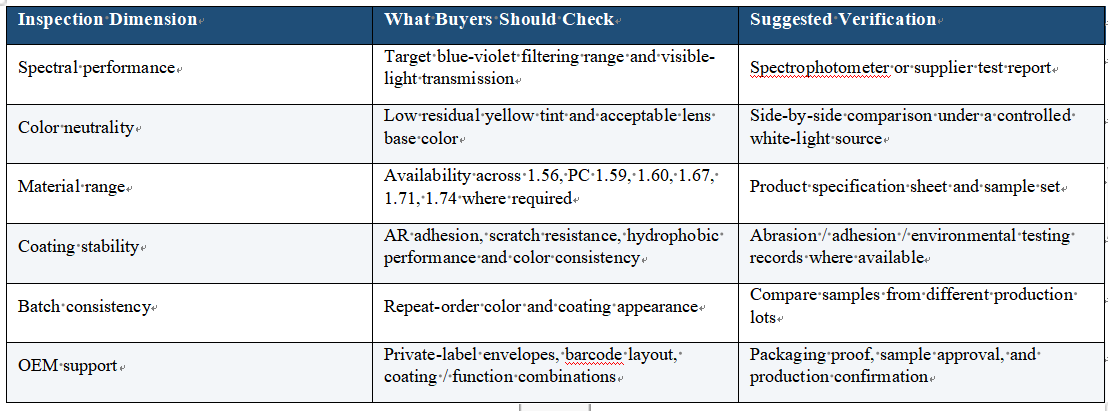
When comparing wholesale suppliers, ask for measurable quality-control information instead of relying only on claims such as "ultra clear" or "maximum protection." A practical evaluation framework is shown below.

4. Why Manufacturing Infrastructure Matters at Scale

For bulk supply, color consistency cannot depend on manual adjustment alone. The coating environment, equipment stability, material preparation, and inspection process all influence repeatability. According to the 2026 CONVOX catalogue, the factory operates 16 Korean NVC vacuum coating machines together with two automatic production lines, with broader resin-lens capacity of up to 50,000 pairs per day across multiple product categories.

The same catalogue describes product testing that includes anti-abrasion evaluation, edging checks, salt-water testing, and a five-procedure inspection process before shipment. These controls are more useful to a buyer than a generic "premium quality" claim because they show which production risks the factory is trying to manage.

5. Coating and Functional Options

A blue-block product is rarely purchased as a substrate alone. Distributors often combine the base lens with anti-reflective coatings, hydrophobic top coats, anti-fog functions, photochromic options, or RX processing. CONVOX lists a range of finishing choices across its single-vision and blue-block protective lens series, including UC, hard coating, HMC and SHMC configurations, with additional functional options depending on product type.

For private-label programs, the important point is to confirm the exact combination by index. A function that is available in 1.56 may not use exactly the same material or coating construction in 1.67 or 1.74. The final specification should therefore be approved by sample before bulk production.

6. RX and Freeform Compatibility

Blue-block technology can also be incorporated into prescription and freeform programs. The CONVOX catalogue shows an RX department equipped for customized prescription production, and the company promotes fast RX processing for suitable orders. For customized blue-block lenses, digital surfacing is used to optimize the back-surface prescription and thickness profile while the selected substrate and coating configuration provide the required functional performance.

For optical labs and chains, it is useful to confirm whether the same blue-block specification can be supplied in single vision, progressive, photochromic, and freeform formats. This reduces the number of suppliers required for a complete product portfolio and helps maintain more consistent branding across different prescription categories.

7. What a Wholesale Buyer Should Request Before Ordering

  • A sample set showing the visual difference between standard blue-cut and clearer blue-block options.
  • Spectral or transmission data for the exact index and coating combination being purchased.
  • Confirmation of available indices, stock power ranges, RX availability, and lead time.
  • Coating and surface-treatment specifications, including the selected AR and hydrophobic options.
  • OEM packaging proof, barcode requirements, and sample approval before mass production.
  • A clear remake or quality-claim process for repeat wholesale orders.

8. FAQ: Sourcing UV420 Blue Block Lenses

Q1: Does a clearer lens mean weaker blue-violet filtering?

Not necessarily. Lens appearance and spectral performance are related but not identical. The result depends on the substrate formulation, target filtering range, coating design, and visible-light transmission. Buyers should compare actual samples and test data for the selected specification.

Q2: Is CONVOX blue-block technology built into the lens material or applied by coating?

Both approaches can be used depending on the product. CONVOX offers substrate-based blue-block configurations and can combine them with vacuum-deposited anti-reflective coatings for additional spectral and surface-performance requirements.

Q3: Which refractive indices are available?

The 2026 CONVOX catalogue lists blue-block protective lens options across 1.56, 1.59, 1.60, 1.67, 1.71 and 1.74, with specific UV and coating configurations varying by product.

Q4: Can blue block be combined with photochromic or progressive lenses?

Yes, selected combinations are available. The final index, prescription range, coating and functional configuration should be confirmed before ordering.

Q5: Can CONVOX support private-label wholesale programs?

Yes. OEM support can include customized envelopes, branding, barcode layouts and product specifications, subject to project requirements and order quantity.

Request a Wholesale Quote or Sample Test

If you are evaluating clearer UV420 blue block lenses for stock, RX, progressive, photochromic, or private-label programs, contact CONVOX to request current product specifications, sample lenses, coating options, and B2B pricing.

Corporate Website: https://www.convox-optical.com/
Contact Email: [email protected]

Media Contact

JIANGSU CONVOX OPTICAL CO.,LTD.


[email protected]

Source :JIANGSU CONVOX OPTICAL CO.,LTD.

This article was originally published by IssueWire. Read the original article here.

More News

Kelana Jaya LRT route disruption: Rapid Rail restoring service

Oct 15, 2024

Kelana Jaya LRT route disruption: Rapid Rail restoring service

KUALA LUMPUR: Repair works are being carried out following a service disruption on the Kelana Jaya LRT Line, involving the track between Wangsa Maju and Sri Rampai Stations, which was caused by an unusual flow of rainwater that damaged several track components, said Rapid Rail Sdn Bhd (Rapid Rail). Rapid Rail as the operator of the Rapid KL rail service in a statement said that the incident occurred at 10.20 am which forced the operation to stop the power supply in the area involved to allow inspection and repair work to be carried out. “Repair works are being actively carried out by Rapid Rail’s technical team to ensure that services can be restored soon,“ according to the statement. For now, a feeder service has been activated between Gombak Station and Wangsa Maju Station. Trains from the direction of Putra Heights will turn back at Wangsa Maju Station. A total of 12 free feeder buses at a frequency of every 15 minutes are operating to ensure that passengers can continue their journey. “We hope that this repair work can be completed before the evening peak hour,“ said Rapid Rail. In addition, operation staff and auxiliary police personnel have been stationed at the stations involved to help facilitate the movement of affected passengers. Continuous announcements on the development of service status will be delivered through Rapid KL’s social media, at all stations, and on trains. Rapid Rail also informed that the latest development of service status will be announced at 3 pm. “Passengers are advised to plan their journeys and refer to Rapid KL’s social media to get the latest information on the service status of the Kelana Jaya LRT Line,“ said the statement. For more information, the public can contact Rapid Rail’s communications officer, Noor Natasha Mohd Irwan at 013-332 2900. Several roads in Kuala Lumpur were flooded following the continuous heavy rain that started at about 9 this morning.

12,519 cases under Weights and Measures Act recorded as of September - KPDN

Oct 15, 2024

12,519 cases under Weights and Measures Act recorded as of September - KPDN

SHAH ALAM: A total of 12,519 cases involving offences under the Weights and Measures Act (ATS) 1972 were recorded by the enforcement division of the Ministry of Domestic Trade and Cost of Living (KPDN) nationwide from 2020 to September this year. KPDN deputy-director of Enforcement (Prevention) Aris Mamat said the statistics reflected the ministry’s ongoing and proactive efforts to ensure that traders adhered to the integrity of weights and measures in buying and selling for the benefit of consumers. “KPDN is committed to protecting consumers and consistently ensuring that traders adhere to established standards. Those found to have committed irregularities or non-compliance will not evade strict enforcement actions. “A violation of the provisions under the ATS 1972 could result in a maximum fine of RM40,000, imprisonment for up to three years, or both, and the court may also order the forfeiture of the weighing instrument,” he said today. He said this after heading a team of 20 KPDN enforcement officers to perform spot checks at three petrol stations around Kuala Selangor to ensure that the fuel charged to consumers matched the amount supplied through pump dispensers. Elaborating, Aris said that the ATS 1972 enforcement compliance inspections at petrol stations led to actions against the misuse of subsidised diesel fuel under Ops Tiris, resulting in the seizure of diesel valued at approximately RM16.5 million from January to September this year. “This brings the total amount of diesel seized from 2020 to 2024 to RM52.68 million,” he said. Commenting on today’s operation, Aris said that it focused on several key aspects, including the accuracy of oil pumps and meters, testing the volume of fuel dispensed, and reviewing the maintenance records of weighing and measuring equipment. He added that checks revealed all the petrol stations involved complied with the weighing and measuring regulations set. “Regarding the enforcement actions under the ATS 1972 in Selangor, we recorded a total of 283 cases from January to September last year, with confiscated items amounting to RM2.6 million,” he said.

Skills-related underemployment shows declining trend

Oct 15, 2024

Skills-related underemployment shows declining trend

KUALA LUMPUR: The skills-related underemployment (SRU) rate has continued to fall in line with improvements in the country’s education level, said Deputy Economy Minister Datuk Hanifah Hajar Taib. SRU is defined as tertiary-educated individuals working in semi-skilled and low-skilled jobs. Hanifah said the SRU rate stood at 37% in the second quarter of 2024, in line with high-income nations such as South Korea (38%), Australia (32%), the United Kingdom (28%), and the United States (30%). “The underemployment rate of STPM holders is 55.8%, while for degree holders, the rate is lower at 26.9%,” she said during the question-and-answer session in the Dewan Rakyat today. She was responding to a supplementary question from Datuk Mohd Shahar Abdullah (BN-Paya Besar) on the government’s efforts to address the mismatch between labour supply and demand, particularly among graduates with a cumulative grade point average (CGPA) of 3.5 and above who qualify for jobs in high-growth sectors. Hanifah explained that the government is actively trying to boost investments in key sectors to create more high-skilled jobs, with initiatives such as the KL20 Action Plan, the National Energy Transition Roadmap, and the New Industrial Master Plan 2030. “These measures will ensure that the country’s economy does not only rely on (just providing) low tax rates but also can meet the demand for high-quality jobs,” she said. Hanifah also emphasised the government’s commitment to developing a comprehensive ecosystem that encourages skilled workers abroad to return home, such as from Singapore where the cost of living is rising. “If the cost of living in Singapore becomes too high, skilled workers might consider returning to Malaysia, where the job ecosystem and quality of life better suit their needs,“ she noted. She added that the government is ready to strengthen upskilling and reskilling initiatives to ensure the workforce meets the needs of high-value and high-growth industries.

National Strategic Plan addresses child malnutrition with comprehensive approach

Oct 15, 2024

National Strategic Plan addresses child malnutrition with comprehensive approach

KUALA LUMPUR: KUALA LUMPUR: The 2022-2030 National Strategic Plan to Combat the Double Burden of Malnutrition Among Children in Malaysia will ensure a more comprehensive approach to addressing issues such as stunting and obesity, said Health Minister Datuk Seri Dr Dzulkefly Ahmad. He expressed hope that the plan would expedite efforts to tackle child malnutrition in order to build a healthy nation and nurture healthy Malaysians from a young age. Dzulkefly said the plan, encompassing five core strategies and 31 initiatives, took into account the functions and policies of all ministries and agencies while emphasising the involvement of various parties and the strengthening of existing strategies through cross-cutting approaches. “The plan prioritises strengthening the governance of nutritional well-being through legislation, political commitment, and stakeholder involvement, while also improving the quality and accessibility of nutritional services and creating a more conducive society. “Efforts to strengthen capacity development and human capital for the well-being of children’s nutrition, along with the synergy of child nutrition advocacy, are also emphasised,” he said during the oral question and answer session at Dewan Rakyat today. Dzulkefly said this in response to a question from Datuk Dr Alias Razak (PN-Kuala Nerus) regarding the ministry’s plan to create a master document, such as the Child Nutrition Action Plan, to address the issue of child nutrition. He said the plan aimed to have a specific impact on children, teenagers, women of reproductive age, and vulnerable groups, designed to mobilise energy effectively among all stakeholders in the implementation of strategies, programmes, and outlined activities. “One of the efforts being strengthened is the initiative to support the first 1,000 days of a child’s life, beginning with the first day of pregnancy and lasting until the child is two years old,” he said. Dzulkefly said among the activities conducted were engagement and advocacy sessions for private pharmacies and health clinics to facilitate early screenings. He said that this included conducting blood haemoglobin tests for women and pregnant mothers to reduce the risk of pregnancy complications, enabling them to plan for a healthy pregnancy.

YOUR NEWS, OUR NETWORK.

Do you have Great News you want to tell the world?

Be it updates about your business or your community, you can make sure that it’s heard by submitting your story to our network reaching hundreds of news sites across 6 verticals.

Suara KL

Suara KL brings amazing Travel news for tourist to witness Beautiful Malaysia and hear the wonderful sounds of this country.

Newsletter