
New Research Consortium Report Explains Why PAYERS Must Take the Lead in Changing the Way We Approach and Treat Cancer

Sep 16, 2026
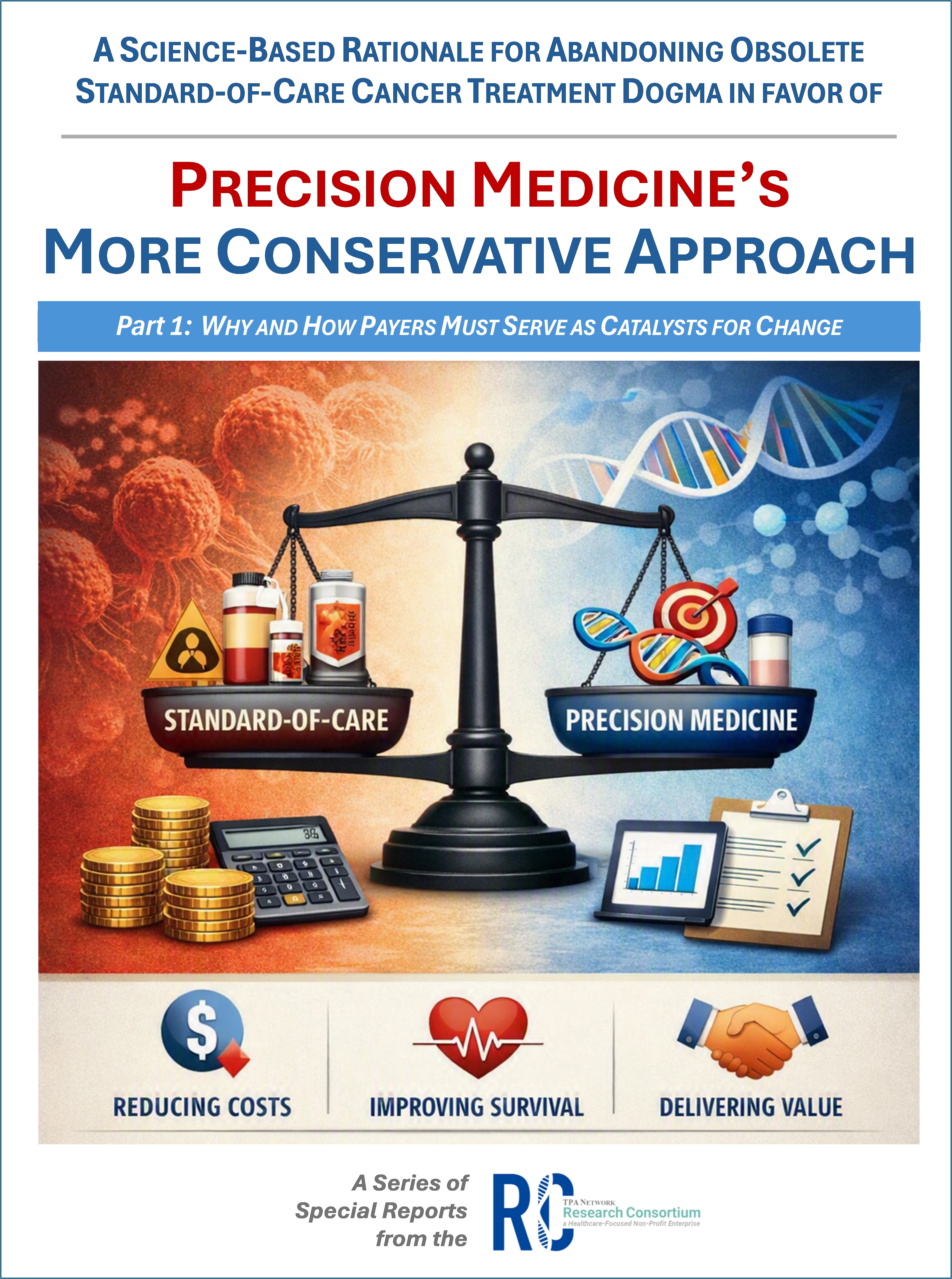

The transition from outdated, one-size-fits-all standard-of-care cancer treatment to science-based personalized care cannot be left to physicians / health systems: it must be led by payers / employer plan sponsors who make critical coverage decisions


San Diego, California Sep 15, 2026 (Issuewire.com) - A new report from the nonprofit TPA Network Research Consortium explains why health insurers must bear much of the responsibility for changing how cancer is approached and treated.  The first-in-a-series report details how payers can help drive this change by following the organization's Precision Medicine Protocol, a framework for supporting a more individualized approach to cancer care.

It is possible that as many as 80% of cancer patients in the United States receive suboptimal care, in large part because of the continued reliance on organ-based, one-size-fits-all clinical guidelines that do not adequately account for the variation among individual cancers.  When treatment decisions are guided by these generalized approaches rather than by the unique characteristics of each patient's cancer, patients may receive toxic, high-cost regimens that offer limited or no clinical value. Instead, treatment should be more appropriately aligned with the biology of the disease it is intended to treat.

Precision medicine integrates modern genomics into cancer care, substantially deepening our understanding of the disease and transforming how it can be treated.  Rather than relying on sameness-based, standard-of-care approaches, it uses each patient's unique molecular profile to guide the selection of therapies that are biologically matched to their cancer.   This approach helps identify targeted and potentially effective drugs while eliminating treatments that are unlikely to provide clinical value.  By avoiding ineffective therapies, precision medicine can reduce unnecessary toxicity and improve outcomes while containing cost.  It is a conservative, more cautious and science-based approach to care -- one that stands in clear contrast to blindly following obsolete, pre-genomic-era treatment dogma.

Research Consortium founder Richard Nicholas, a 48-year healthcare industry veteran, believes that payers continue to perpetuate suboptimal cancer care because they have not made a meaningful commitment to precision medicine. In his view, that commitment is essential to ensuring that cancer treatment decisions better reflect the unique characteristics of each patient's cancer.

"Organ-based cancer treatment must be superseded, as it excuses decision-making based on incomplete knowledge.  By contrast, precision medicine's science-based, look-before-you-leap treatment approach is actually a more conservative course of action versus blindly following obsolete pre-genomic era dogma.

"It is high time for payers and health plan sponsors to earnestly embrace precision medicine.  To do otherwise would be to continue to deny patients access to vital genomic testing and the option to try potentially viable FDA-approved cancer drugs; essentially permitting continued wasteful spending on high-cost, low-clinical-value drugs"   Richard L. Nicholas

Payers' Responsibility to Advance Precision Medicine

Comprehensive health care coverage is a cornerstone of effective cancer care; and coverage decisions shape access, quality, cost, and outcomes throughout the cancer journey, influencing everything from the initiation of treatment through long-term survivorship. When coverage decisions deny, delay, or disrupt access to care, they affect not only the treatment patients receive but also the outcomes they experience. Nicholas believes that because payers make coverage decisions, much of the responsibility for driving the transition to precision medicine rests with them.  He reasons that responsibility cannot rest entirely with providers and health systems, which do not control coverage determinations.  Payers must therefore earnestly embrace precision medicine and support coverage decisions that advance more effective cancer care, rather than continuing to accept ineffective treatments and wasteful spending on them.

A Practical Framework for Advancing Precision Medicine

To help health insurers and self-funded employers drive meaningful change, the nonprofit Research Consortium created a Precision Medicine Protocol as a practical framework for supporting more effective, individualized cancer care.  This report, the first in a series on precision medicine, describes the protocol and explains how and why payers can support its use. It also examines how payers can promote cancer care that is better aligned with individual patient needs while addressing the quality, cost, and value considerations that shape coverage decisions. Later installments in the series will provide additional detail about the protocol, challenge conventional thinking about the cost and value of combination drug treatments and show payers how to gain greater control over oncology specialty-drug spending.

The report is available for download here.

Should you wish to learn more about how you can support our work, please click on this link to our new fundraising campaign, Advancing Personalized Cancer Care.  Cancer patients everywhere will be glad you did.

About the TPA Network Research Consortium

The TPA Network Research Consortium is a non-profit, industry-wide healthcare research initiative that helps providers evaluate and assess new medical technologies and innovations, plan participants  obtain leading-edge healthcare, scientists  advance medical research, and payers reduce risk ... by conducting payer-focused translational research, in real-world settings.  Visit ResearchConsortium.org
Media Contact

TPA Network Research Consortium, Ltd.


[email protected]

8583954114

555 Saturn Blvd, Suite B408

http://www.ResearchConsortium.org

Source :TPA NETWORK RESEARCH CONSORTIUM LIMITED

This article was originally published by IssueWire. Read the original article here.

More News
Kelana Jaya LRT route disruption: Rapid Rail restoring service

Oct 15, 2024

Kelana Jaya LRT route disruption: Rapid Rail restoring service

KUALA LUMPUR: Repair works are being carried out following a service disruption on the Kelana Jaya LRT Line, involving the track between Wangsa Maju and Sri Rampai Stations, which was caused by an unusual flow of rainwater that damaged several track components, said Rapid Rail Sdn Bhd (Rapid Rail). Rapid Rail as the operator of the Rapid KL rail service in a statement said that the incident occurred at 10.20 am which forced the operation to stop the power supply in the area involved to allow inspection and repair work to be carried out. “Repair works are being actively carried out by Rapid Rail’s technical team to ensure that services can be restored soon,“ according to the statement. For now, a feeder service has been activated between Gombak Station and Wangsa Maju Station. Trains from the direction of Putra Heights will turn back at Wangsa Maju Station. A total of 12 free feeder buses at a frequency of every 15 minutes are operating to ensure that passengers can continue their journey. “We hope that this repair work can be completed before the evening peak hour,“ said Rapid Rail. In addition, operation staff and auxiliary police personnel have been stationed at the stations involved to help facilitate the movement of affected passengers. Continuous announcements on the development of service status will be delivered through Rapid KL’s social media, at all stations, and on trains. Rapid Rail also informed that the latest development of service status will be announced at 3 pm. “Passengers are advised to plan their journeys and refer to Rapid KL’s social media to get the latest information on the service status of the Kelana Jaya LRT Line,“ said the statement. For more information, the public can contact Rapid Rail’s communications officer, Noor Natasha Mohd Irwan at 013-332 2900. Several roads in Kuala Lumpur were flooded following the continuous heavy rain that started at about 9 this morning.

12,519 cases under Weights and Measures Act recorded as of September - KPDN

Oct 15, 2024

12,519 cases under Weights and Measures Act recorded as of September - KPDN

SHAH ALAM: A total of 12,519 cases involving offences under the Weights and Measures Act (ATS) 1972 were recorded by the enforcement division of the Ministry of Domestic Trade and Cost of Living (KPDN) nationwide from 2020 to September this year. KPDN deputy-director of Enforcement (Prevention) Aris Mamat said the statistics reflected the ministry’s ongoing and proactive efforts to ensure that traders adhered to the integrity of weights and measures in buying and selling for the benefit of consumers. “KPDN is committed to protecting consumers and consistently ensuring that traders adhere to established standards. Those found to have committed irregularities or non-compliance will not evade strict enforcement actions. “A violation of the provisions under the ATS 1972 could result in a maximum fine of RM40,000, imprisonment for up to three years, or both, and the court may also order the forfeiture of the weighing instrument,” he said today. He said this after heading a team of 20 KPDN enforcement officers to perform spot checks at three petrol stations around Kuala Selangor to ensure that the fuel charged to consumers matched the amount supplied through pump dispensers. Elaborating, Aris said that the ATS 1972 enforcement compliance inspections at petrol stations led to actions against the misuse of subsidised diesel fuel under Ops Tiris, resulting in the seizure of diesel valued at approximately RM16.5 million from January to September this year. “This brings the total amount of diesel seized from 2020 to 2024 to RM52.68 million,” he said. Commenting on today’s operation, Aris said that it focused on several key aspects, including the accuracy of oil pumps and meters, testing the volume of fuel dispensed, and reviewing the maintenance records of weighing and measuring equipment. He added that checks revealed all the petrol stations involved complied with the weighing and measuring regulations set. “Regarding the enforcement actions under the ATS 1972 in Selangor, we recorded a total of 283 cases from January to September last year, with confiscated items amounting to RM2.6 million,” he said.

Skills-related underemployment shows declining trend

Oct 15, 2024

Skills-related underemployment shows declining trend

KUALA LUMPUR: The skills-related underemployment (SRU) rate has continued to fall in line with improvements in the country’s education level, said Deputy Economy Minister Datuk Hanifah Hajar Taib. SRU is defined as tertiary-educated individuals working in semi-skilled and low-skilled jobs. Hanifah said the SRU rate stood at 37% in the second quarter of 2024, in line with high-income nations such as South Korea (38%), Australia (32%), the United Kingdom (28%), and the United States (30%). “The underemployment rate of STPM holders is 55.8%, while for degree holders, the rate is lower at 26.9%,” she said during the question-and-answer session in the Dewan Rakyat today. She was responding to a supplementary question from Datuk Mohd Shahar Abdullah (BN-Paya Besar) on the government’s efforts to address the mismatch between labour supply and demand, particularly among graduates with a cumulative grade point average (CGPA) of 3.5 and above who qualify for jobs in high-growth sectors. Hanifah explained that the government is actively trying to boost investments in key sectors to create more high-skilled jobs, with initiatives such as the KL20 Action Plan, the National Energy Transition Roadmap, and the New Industrial Master Plan 2030. “These measures will ensure that the country’s economy does not only rely on (just providing) low tax rates but also can meet the demand for high-quality jobs,” she said. Hanifah also emphasised the government’s commitment to developing a comprehensive ecosystem that encourages skilled workers abroad to return home, such as from Singapore where the cost of living is rising. “If the cost of living in Singapore becomes too high, skilled workers might consider returning to Malaysia, where the job ecosystem and quality of life better suit their needs,“ she noted. She added that the government is ready to strengthen upskilling and reskilling initiatives to ensure the workforce meets the needs of high-value and high-growth industries.

National Strategic Plan addresses child malnutrition with comprehensive approach

Oct 15, 2024

National Strategic Plan addresses child malnutrition with comprehensive approach

KUALA LUMPUR: KUALA LUMPUR: The 2022-2030 National Strategic Plan to Combat the Double Burden of Malnutrition Among Children in Malaysia will ensure a more comprehensive approach to addressing issues such as stunting and obesity, said Health Minister Datuk Seri Dr Dzulkefly Ahmad. He expressed hope that the plan would expedite efforts to tackle child malnutrition in order to build a healthy nation and nurture healthy Malaysians from a young age. Dzulkefly said the plan, encompassing five core strategies and 31 initiatives, took into account the functions and policies of all ministries and agencies while emphasising the involvement of various parties and the strengthening of existing strategies through cross-cutting approaches. “The plan prioritises strengthening the governance of nutritional well-being through legislation, political commitment, and stakeholder involvement, while also improving the quality and accessibility of nutritional services and creating a more conducive society. “Efforts to strengthen capacity development and human capital for the well-being of children’s nutrition, along with the synergy of child nutrition advocacy, are also emphasised,” he said during the oral question and answer session at Dewan Rakyat today. Dzulkefly said this in response to a question from Datuk Dr Alias Razak (PN-Kuala Nerus) regarding the ministry’s plan to create a master document, such as the Child Nutrition Action Plan, to address the issue of child nutrition. He said the plan aimed to have a specific impact on children, teenagers, women of reproductive age, and vulnerable groups, designed to mobilise energy effectively among all stakeholders in the implementation of strategies, programmes, and outlined activities. “One of the efforts being strengthened is the initiative to support the first 1,000 days of a child’s life, beginning with the first day of pregnancy and lasting until the child is two years old,” he said. Dzulkefly said among the activities conducted were engagement and advocacy sessions for private pharmacies and health clinics to facilitate early screenings. He said that this included conducting blood haemoglobin tests for women and pregnant mothers to reduce the risk of pregnancy complications, enabling them to plan for a healthy pregnancy.

YOUR NEWS, OUR NETWORK.

Do you have Great News you want to tell the world?

Be it updates about your business or your community, you can make sure that it’s heard by submitting your story to our network reaching hundreds of news sites across 6 verticals.

Suara KL

Suara KL brings amazing Travel news for tourist to witness Beautiful Malaysia and hear the wonderful sounds of this country.

Newsletter